
Reviewed · MEXICO CITY HISTORIC CENTER WALKING TOURS
Walking Tour of the Historic Center in Mexico City
Mexico City’s Historic Center is built over Tenochtitlan, the Aztec capital, and this walking tour helps you see both cities at once. You move from the remains of the Great Temple to a cathedral, grand public squares, tiled colonial buildings, and the murals of Bellas Artes. The best guides, including Andrés, Eduardo, Ivan, and Diana, add the links between those places.
I like the strong historical arc and the chance to notice details you could easily pass by alone. I also like the private-tour option, since you can spend more time on art, archaeology, architecture, or food stops that fit the route. The main consideration is that the tour can become a standing lecture if you do not tell your guide that you want more walking, photos, and seated breaks.
Key points to know before you book
- Aztec roots come first: Spend about 40 minutes around the Templo Mayor ruins and museum area, where modern streets reveal the old city beneath them.
- The route covers major sights: You see the Metropolitan Cathedral, Zócalo, House of Tiles, Palacio Postal, and Palacio de Bellas Artes.
- Private tours are flexible: You can adjust the time at each stop and request a nearby market, restaurant, or attraction if it fits the three-hour route.
- The guide makes the difference: Andrés, Eduardo, Ivan, Ariana, Ari, Francisco, and Diana have each led highly praised tours, with art and city history as common strengths.
- Plan for walking and standing: Wear comfortable shoes, carry water and sun protection, and tell the guide in advance about knee or mobility concerns.
- Check your meeting point: The small-group departure is listed at MUMEDI, while the general meeting information names Bellas Artes. Confirm the exact place and time before setting out.
Why this walk works as a first look at central Mexico City
The Historic Center can feel like several cities pressed into one. Aztec stones, Spanish colonial churches, 19th-century commercial buildings, and 20th-century Mexican art all occupy the same few blocks. A guide gives you a way to connect those layers instead of treating each building as a separate photo stop.
The tour lasts about three hours and costs $29 per person in the advertised format. That is fair value if you want a private local guide to explain what you are seeing and help you orient yourself. The price does not cover meals, insurance, personal expenses, tips, or admission fees, so budget for those separately. The scheduled stops are generally viewed from public areas, but Palacio de Bellas Artes admission is not included.
I would book this early if your Mexico City dates are fixed. The experience is booked an average of 31 days ahead, and private departures require a chosen time. Small-group departures have more limited scheduling, while private tours can be arranged at a preferred hour.
More walks through the historic centre:
- Historic Downtown Walking Tour
★ 5.0 · 1,289 reviews - Historic Center Food Tour in Mexico City
★ 5.0 · 1,263 reviews - Mexico City: Historic Downtown Walking Tour
★ 4.8 · 1,039 reviews
Templo Mayor: Mexico City beneath your feet
The tour begins with the Aztec world at Museo del Templo Mayor. You spend about 40 minutes learning how the remains of the Great Temple and nearby structures fit into the old city. Some foundations date to the 14th century, making this more than a quick look at scattered ruins.
This is the place where a good guide earns the fee. You learn about the Aztec political and social system, religious ideas, daily life, and the empire’s reach across central Mexico. You also hear how the city changed during the first years of Spanish colonization in 1519.
I would not rush this stop. The ruins can look stark if you do not know what you are seeing, and the surrounding modern streets make the old city hard to picture. Ask your guide to point out how the archaeological remains relate to the present-day neighborhood. That connection is one of the strongest parts of the walk.
The museum entrance is listed as free for this experience, but the tour information also says entrance fees are not included. Confirm what your booking covers if you want to enter exhibition spaces rather than view the archaeological area from the route.
The Metropolitan Cathedral and the long colonial timeline
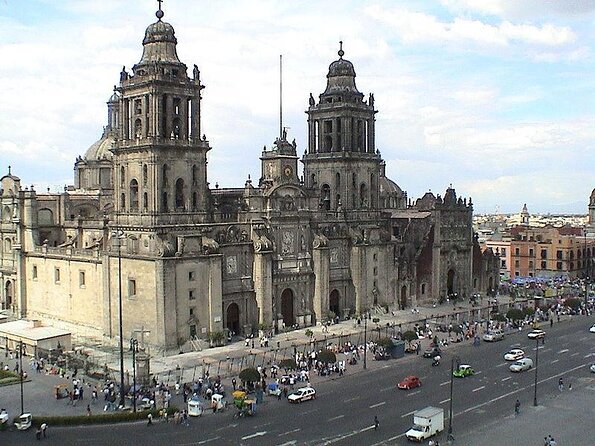
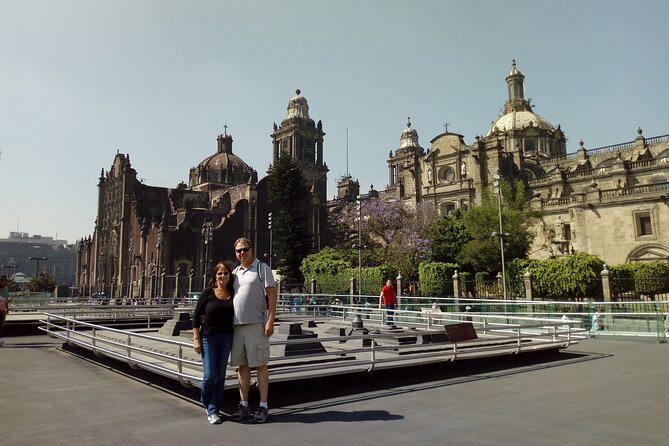
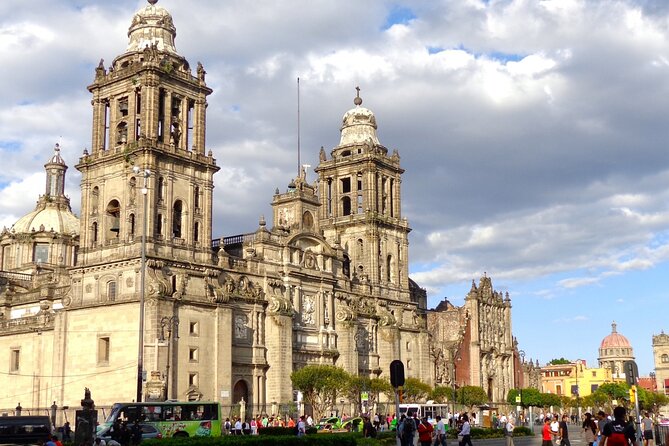
From the Aztec remains, the route moves to Catedral Metropolitana de la Ciudad de Mexico. Allow about 30 minutes here. The cathedral dates from the 16th century and brings together several architectural and artistic styles, the result of repeated building campaigns over many generations.
This stop gives you a clear lesson in how Mexico City changed after the conquest. The cathedral is not just one finished design. Its details reflect different periods and different builders, with later work adding the styles and techniques of its own day.
Take time to look up and around rather than only photographing the facade. Your guide can help you notice the building’s layered appearance and explain why it became such an important religious and civic place. The cathedral is listed with no admission charge for the tour, though the general terms advise you to account for entrance fees yourself.
A practical point: the schedule allows only half an hour. That is enough for an introduction, but not for a long, quiet examination of every chapel, artwork, or architectural detail. If the cathedral matters greatly to you, ask during a private tour if the time can be adjusted.
Zócalo: the city’s great public room
The next 40 minutes focus on Zócalo, the huge central square. It has served as a gathering place since Aztec times and continues to host ceremonies, festivals, political events, and military parades.
This is a useful pause in the route because the square helps you understand Mexico City at a civic scale. Around it are buildings that have witnessed the city’s change across centuries. Your guide can explain what you are looking at, but you should also leave room to watch the square itself. It is a public stage, and its meaning comes from how people use it.
The drawback is the same one that comes with any large open plaza: the guide may spend too long talking while you stand in the middle of it. One lower-rated experience specifically involved too much standing and not enough walking or sitting, along with a failure to account for a knee problem. Take that warning seriously. Tell your guide at the start if you need benches, shorter explanations, or a more active pace.
For photos, this is one of the route’s easiest places to work. You have broad views and several major buildings close together. Carry a hat, sunscreen, sunglasses, and water, especially for a sunny afternoon departure.
More Historical Tours in Mexico City:
- Walking Tour of the Historic Center of Mexico City
★ 5.0 · 870 reviews - Mexico City Historical Centre Food Tour with 7 Authentic Tastings
★ 5.0 · 723 reviews - Walking Tour in Mexico City for Exploring their Cultural Heritage
★ 5.0 · 245 reviews - Walking Tour – Impressive murals in Historical Center of Mexico City
★ 5.0 · 224 reviews
House of Tiles: a small building with plenty to see
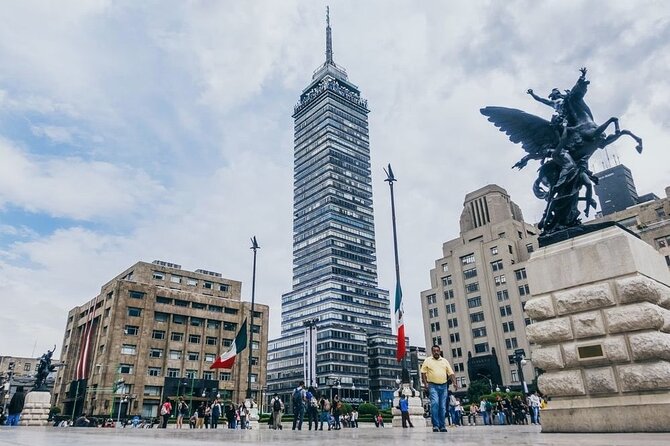
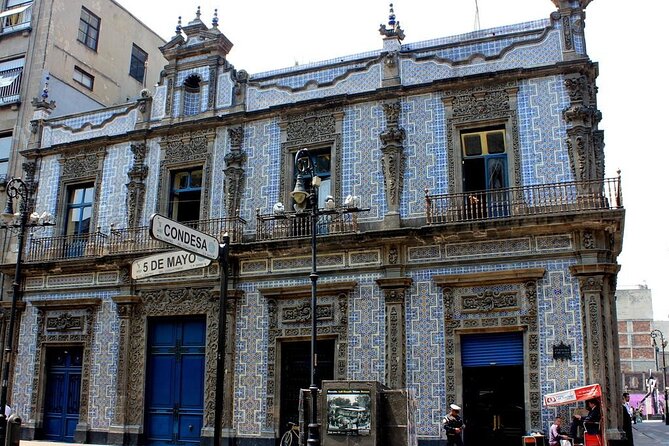
After the main square, you walk toward the House of Tiles, one of the Historic Center’s most attractive colonial buildings. Its facade is covered with colorful Talavera tiles that have survived for centuries, giving the building an immediately recognizable look.
The stop lasts about 20 minutes. Inside, you can see a mural by José Clemente Orozco, along with a glass-roofed atrium, stone pillars, murals, and a fountain. This is a good change of scale after the broad Zócalo. Instead of another monumental public building, you get a closer look at decoration, craft, and interior design.
If you want a drink or a bite, the nearby Café Azulejos can fit naturally into a private tour when time allows. One itinerary variation included a stop there, with an affordable setting that worked well after the walk. Do not assume a meal is part of the tour, though. Food and drinks are your responsibility.
The private format is useful here. You can ask the guide to linger over Orozco’s work or move along if you are more interested in archaeology than architecture. On the small-group version, the route and timing are fixed.
Palacio Postal: ornate details in a working post office
The Palacio Postal is another short stop, usually about 20 minutes. This Art Nouveau building is known for its ornate facade and lavish interior details, including gargoyles, marble decoration, and plasterwork.
It remains a working post office and also has a museum with objects and historical documents. That combination makes the building especially appealing. You are not looking at a preserved shell that has lost its original purpose. You can appreciate the design while seeing the place still function as part of city life.
This is a stop for close observation. Look at the smaller details rather than only taking a wide shot. The building’s decorative work rewards a slow scan of the interior, but the scheduled time is brief, so your guide’s explanations help you focus.
Photography is a major part of the appeal here. The tour encourages you to take pictures as you go, and the Postal Palace gives you some of the most polished architectural backgrounds on the route.
Bellas Artes: a strong finish in art and architecture
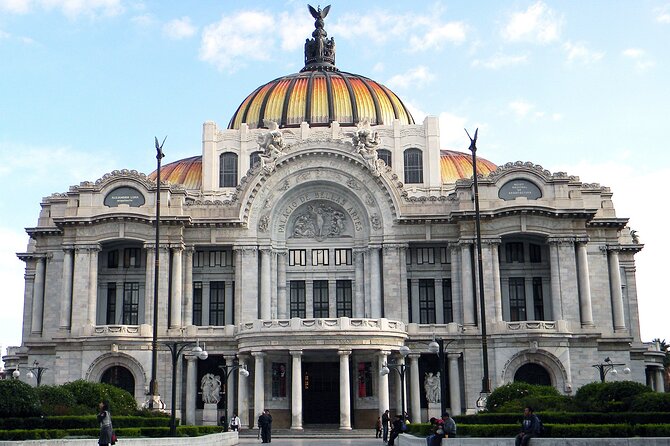
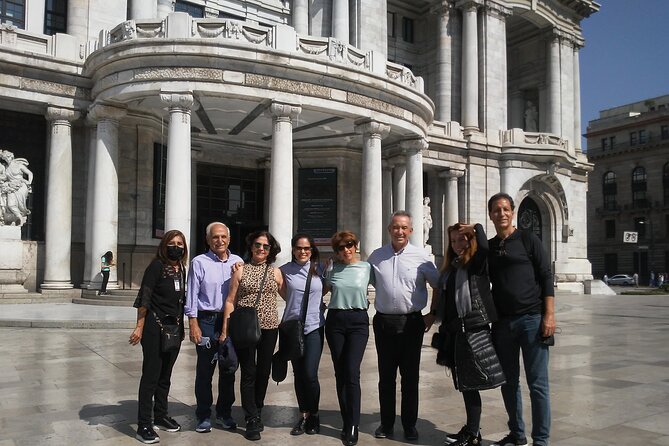
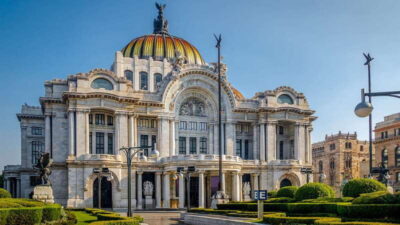
The tour ends outside Palacio de Bellas Artes, one of Mexico City’s key performance and cultural venues. The building dates from the early 20th century and is known for its architecture as well as murals by Diego Rivera, David Alfaro Siqueiros, José Clemente Orozco, and other leading Mexican artists of the 1930s.
The listed stop lasts about 20 minutes and takes place outside. Admission is not included. That matters because the building’s interior murals are one of the main reasons many people want to visit. If you want more than an exterior introduction, ask your guide how to add an interior visit or plan to return on your own.
Ending here makes sense. You finish with Mexican art and public culture rather than another lesson about colonial construction. Bellas Artes hosts operas, recitals, lectures, temporary exhibitions, and other cultural events, so it can also help you plan another evening in the city.
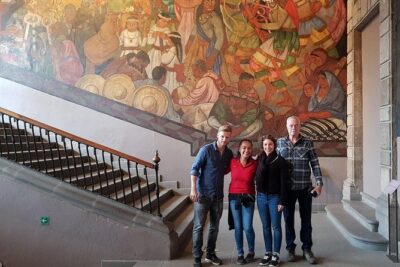
One guide made a particular effort to include the murals despite the route’s short time. That is worth requesting if art is a priority. A private tour gives you the best chance of doing so, though extending the tour or changing the route can cost extra.
Private, small-group, and semi-private choices
The advertised $29 price needs a close look. It is a per-person price, but the private-tour rate changes with the number of people in your booking. Only your group participates on a private tour, while the semi-private format allows up to 12 people.
The private option is the better fit if you want control. You can choose the start time, adjust how long you spend at each sight, and ask to include a nearby market, restaurant, or attraction without changing the main route. The extra stop must fit within the standard duration and cannot require a major route change. A longer tour, a new route, or extra participants requires advance notice and an additional fee.
The small-group option is less flexible. It departs on Saturday at 2:30 PM, is not customizable, and is offered in English and Spanish. The supplied information gives MUMEDI, at Avenida Francisco I. Madero 74, as the small-group meeting place.
There is a conflicting general meeting-point note that names Palacio de Bellas Artes, at Avenida Juárez, as both the start and finish. Do not guess. Contact the company and confirm the meeting point for your exact booking. The tour does not include transportation from your hotel or the airport. Pickup or drop-off can be arranged for an extra fee if requested ahead of time.
The guides and the kind of experience they create
The strongest part of this tour is the human explanation. Andrés brings an academic background in Mexican history. Eduardo has been especially good at making the walk informative and adapting to the group. Ivan is a strong choice for archaeology, architecture, and art, and one tour continued as a conversation in a cafe when rain arrived.
Ariana has been praised for connecting geography, culture, and history into one clear picture. Ari is a good fit if you want practical suggestions about places to see in the center. Diana has communicated through WhatsApp before the tour, adjusted well to specific needs, and even helped include an exhibition of painter Covarrubias.
Francisco Cabral Vignola has also received praise for presenting the sites with passion. The guide you receive depends on availability, so you cannot count on a specific person unless the company confirms it.
All guides are bilingual in at least Spanish and English. French, German, Italian, Portuguese, or Mandarin may be possible, but those languages are not guaranteed. If you need a language other than English or Spanish, ask before booking.
Who should book this walk?
I would recommend it to a first-time visitor who wants a clear introduction to central Mexico City. It is also a good choice for anyone who likes architecture, Aztec archaeology, Mexican muralism, or taking photos of ornate buildings.
Families can benefit from the private format because the pace can be adjusted. Couples and solo visitors may appreciate having a local guide explain the city without joining a large coach group. The route also works well at the beginning of a stay, since it gives you useful orientation for later visits.
I would be cautious if you have difficulty standing or walking and do not plan to speak up. Most people can participate, but the tour involves walking between stops and listening on city streets. Tell the guide before departure if you need to sit, slow down, or spend less time in open areas.
Bring comfortable clothing and shoes, a hat or cap, sunscreen, sunglasses, cash, identification, and proof of travel insurance. A valid phone number with the international prefix is important because the guide may need to reach you. If the guide cannot find or contact you, the booking may be treated as a no-show.
Cancellation and weather notes
You can cancel for a full refund up to 24 hours before the start time. Changes made within 24 hours are not accepted, and cancellations inside that period are not refunded.
The experience requires good weather. If poor weather causes cancellation, you can choose another date or receive a full refund. Rain can also affect the walking pace, so a private booking is useful if you want the option of taking a short cafe break, as one guide did during a wet afternoon.
Should you book the Historic Center walking tour?
Book it if you want the main sights tied together by a local guide rather than visited as isolated buildings. The Aztec ruins, cathedral, Zócalo, House of Tiles, Palacio Postal, and Bellas Artes form a smart three-hour introduction, and the $29 price is reasonable for that amount of guided context.
Choose the private version if you care about murals, need a slower pace, or want to add a nearby cafe, market, or attraction. Choose the small-group option if Saturday afternoon works and you prefer a lower-cost, fixed route.
Before paying, confirm the exact meeting point, what entrance fees apply, and whether the guide can accommodate your walking needs. With those details settled, this is a practical way to see how Mexico City’s Aztec, colonial, and modern identities occupy the same streets.
FAQ
How long does the walking tour last?
The standard tour lasts approximately three hours, including the route between the listed stops. A private tour can require an extra fee if you want to extend the duration.
What places are included?
The route includes Museo del Templo Mayor, the Metropolitan Cathedral, Zócalo, the House of Tiles, Palacio Postal, and Palacio de Bellas Artes.
Is the tour private or shared?
The private option includes only your group. The semi-private option can include up to 12 people. The small-group format is not customizable.
Where does the tour meet?
The small-group information lists MUMEDI, at Avenida Francisco I. Madero 74, with departure on Saturday at 2:30 PM. Another meeting-point note lists Palacio de Bellas Artes. Confirm the exact location for your booking before the tour.
Is transportation included?
No. Hotel and airport transportation are not included. Pickup or drop-off can be arranged for an extra fee if requested in advance.
Can I cancel for a refund?
Yes. You can receive a full refund if you cancel at least 24 hours before the scheduled start time. If poor weather causes the company to cancel, you can choose a different date or receive a full refund.
More Walking Tours in Mexico City
- Frida Kahlo VIP [Museum Tickets Included] Walk, Markets & Churros
★ 5.0 · 982 reviews - Anthropology Museum Private Experience Walking Tour
★ 5.0 · 355 reviews - Muralist Art Semi Private Walking Tour in Mexico City Downtown
★ 5.0 · 188 reviews - Coyoacán Walking Tour: Access to Frida Kahlo Museum & Tacos
★ 5.0 · 181 reviews
Just added around Mexico City
- Xochimilco’s Wild Side: Mezcal, Insects & Culture★ 4.9 · 10 reviews
- Xochimilco: Food and Trajinera Ride with Local Women★ 5.0 · 5 reviews
- Xochimilco: Island of the Dolls Tour Games and Drinks★ 5.0 · 25 reviews
- Xochimilco Ecological Tour – Away From the Crowds (3 Hours)★ 5.0 · 15 reviews
- Xochimilco + Coyoacán Combo Full-Day Tour★ 5.0 · 3 reviews
- Xochimilco floating gardens, Coyoacan and UNAM murals★ 4.0 · 6 reviews
- Val´quirico And The City of Angels Puebla From Mexico City★ 5.0 · 3 reviews
- Xochimilco: amanecer en kayak Ciudad de México★ 5.0 · 35 reviews
Mexico City Historic Center Walking Tours, compared.




Walking Tour – Impressive murals in Historical Center of Mexico City
Read our review →
Muralist Art Semi Private Walking Tour in Mexico City Downtown
Read our review →Browse the lists this tour appears in