Reviewed · PRIVATE
Private Contrasts of Mexico City Neighborhoods Tour
Mexico City reveals itself best from several angles, and this private tour gives you one of the most unusual: a long ride above the city in the Cablebús. You will pass colorful homes, sloping streets, murals, and the distant volcanoes before returning by road through wealthy, modern, historic, and traditional districts.
I like two things here. First, the private format lets you see a wide slice of the capital without following a large group. Second, hotel pickup, a driver, and the cable car fare are included, so you can focus on the view instead of piecing together a complicated route. The main consideration is time: three hours is enough for a broad overview, but not for lengthy walks or museum visits.
Key points at a glance
- About 40 minutes above the city: The Cablebús ride covers more than six miles, giving you an unusual view of homes, murals, roads, and hills.
- A private vehicle throughout: Your group travels with its own guide and driver rather than sharing the tour with strangers.
- Sharp neighborhood contrasts: Centro Histórico, Reforma, Las Lomas, the financial district, and a traditional settlement all appear in one compact outing.
- Hotel pickup included: The service picks you up and returns you to your hotel, but pickup is not available in Santa Fe.
- A useful first-day orientation: You see major parts of Mexico City quickly, which can help you decide where to spend more time later.
- Five-star satisfaction so far: The two detailed comments describe the guide and driver as friendly, informative, and worth the price.
Mexico City from the Cablebús
The Cablebús is the heart of this outing. Rather than seeing Mexico City only from street level, you travel above it for roughly 40 minutes, covering more than six miles according to one detailed account of the ride.
That distance matters. This is not a quick tourist lift up a hill followed by a photograph. You get time to watch neighborhoods change below you. Colorful houses, murals, busy roads, and sloping terrain pass beneath the cabins. On a clear day, you may also see the slopes of a volcano.
I like this section because it shows how huge Mexico City is. At street level, it is easy to focus on a single district and assume that it represents the whole capital. From the cable car, you see a wider pattern: dense housing, open patches, distant hills, and the constant movement of a city spread across a broad basin.
The ride is also the most distinctive part of the tour. Many city excursions move between landmarks by van. This one uses public transport as an experience in its own right. You are not simply looking at a cable car from below. You are riding with the city and seeing parts of it that are easy to miss from a standard sightseeing route.
Still, keep your expectations in check. The Cablebús is a working form of transportation, not a private observation deck. The view can depend on weather, traffic around the stations, and where you are seated. You also will not have unlimited time to stop at every neighborhood below. The value comes from the moving panorama and the guide’s explanations.
More private tours in Mexico City:
- Teotihuacan Private Tour from Mexico City
★ 5.0 · 1,890 reviews - Private Tour: Teotihuacan and Guadalupe Shrine
★ 5.0 · 938 reviews - Private City Tour in Frida Kahlo, Coyoacan, and Xochimilco
★ 5.0 · 626 reviews
Starting among imperial buildings in Centro Histórico
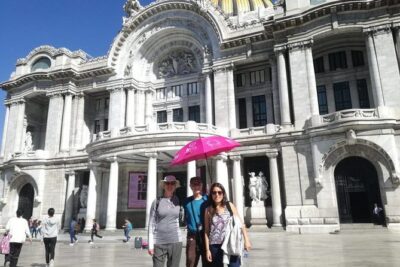
The tour begins with Mexico City’s Centro Histórico, the natural place to meet the capital’s past. You can expect imperial-era buildings, museums, and streets packed with reminders of the city’s long development.
This stop is more of an orientation than a full walking tour. The complete experience lasts about three hours and includes several districts, so you should not expect enough time to enter a number of museums or study every building in detail. Instead, your guide helps place the rest of the outing in context.
I find that useful because the tour soon moves far from the center. After seeing historic streets and major buildings, you can better understand the contrast between old Mexico City and the newer districts you pass later. The center also gives the tour a clear beginning and ending, which makes the route feel like a loop rather than a simple transfer across town.
At the end, you have time to walk around the historic center. The supplied details do not promise a set amount of free time, so think of this as an opportunity to continue exploring if the schedule allows, not as a separate extended walking excursion.
Reforma, monuments, and the city’s public stage
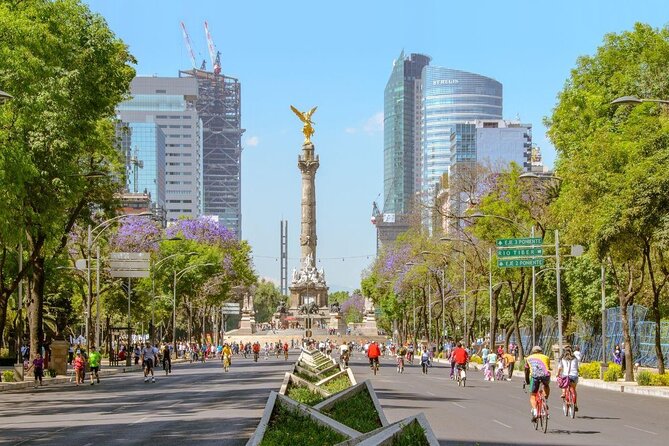
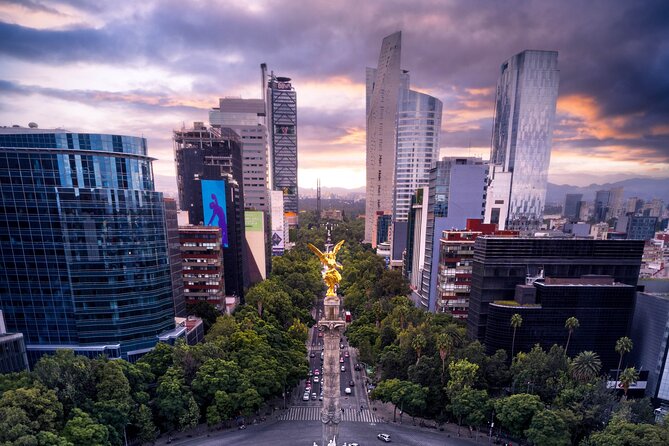
The route then crosses Mexico City’s most important avenue, where concerts, protests, cultural activities, and public events take place. This is the part of the tour that connects daily city life with national symbols.
You will see the monument to Independence and Torre Reforma, giving you two very different markers of the city. One points to Mexico’s national story. The other represents the modern high-rise city and its expanding business center.
I like this drive because an avenue can tell you more than an isolated monument. You see how people use the city, how grand public events fit into ordinary traffic, and how historic symbols share space with offices and towers. Your guide can also help explain what you are seeing as you move between districts.
The tradeoff is that this is mainly a drive-by experience. You should not count on getting out at every major landmark. If your priority is a long, carefully framed visit to the Independence monument or Torre Reforma, a dedicated walking route would serve you better.
Las Lomas and the polished side of the capital
Las Lomas brings a different mood. The tour passes through one of Mexico City’s most exclusive areas, where the emphasis is on luxury, large residences, and a more polished urban setting.
This contrast is one of the strongest reasons to choose the tour. Within a short period, you move from colorful hillside housing and working city streets to an area associated with wealth and privacy. The point is not simply to label one district rich and another poor. It is to see how geography, architecture, roads, and public space change from one part of the capital to another.
Because you remain in the vehicle, you will see Las Lomas as part of a broader drive rather than as a neighborhood walk. That is practical for a three-hour tour, though it limits personal interaction. You are looking at the area from the road and listening to your guide rather than spending time in local shops or cafes.
A completely different kind of day in Mexico City:
- Teotihuacan, Guadalupe Shrine & Tlatelolco Day Tour with Lunch
★ 5.0 · 11,603 reviews - Xochimilco, Coyoacan and Frida Kahlo with Optional Lunch
★ 4.5 · 7,320 reviews - Balloon flight + Breakfast in cave + Pyramids + Pick up CDMX.
★ 5.0 · 6,335 reviews - Teotihuacan pyramids morning or afternoon without tourist traps
★ 5.0 · 6,186 reviews
The capital’s great urban park
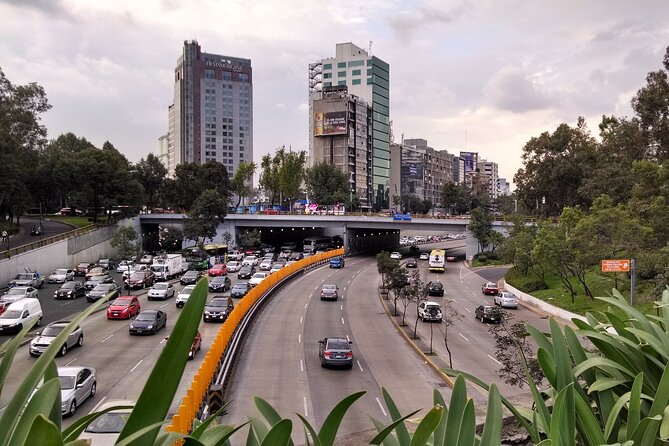
The route also passes through Mexico City’s largest urban park, described as a place filled with fountains, lakes, sports areas, and archaeological remains. It is often called the city’s lung because of its scale and open space.
This stop gives the tour a needed pause from towers, traffic, and dense housing. You can see how the capital makes room for recreation, water, sports, and historic remains inside a vast metropolitan area.
The park is an important part of the city’s identity, but the schedule does not promise a long walk or a visit to a particular museum or archaeological site. If you want to explore the park properly, plan a separate visit. Here, the benefit is seeing its place in the city and getting a sense of its size.
For me, this is another reason the route works as an introduction. You are not looking at Mexico City as a single mass of buildings. The itinerary includes public green space, high-rise districts, old streets, and hillside neighborhoods.
Skyscrapers in the financial district
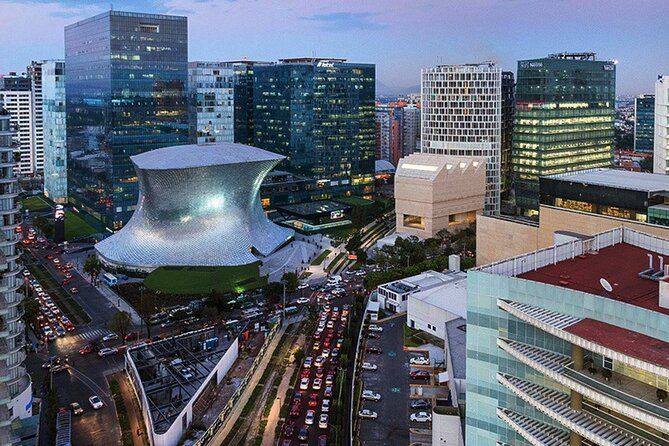
The financial and economic district adds yet another layer. You pass large office buildings, universities, international hotels, and residential homes, all in the same broad zone.
This section may be less visually dramatic than the Cablebús, but it is useful. It shows where business, higher education, hospitality, and private living overlap. The tall buildings also create a clear contrast with the low-rise homes seen from the cable car.
I would treat this as a moving city lesson rather than a landmark stop. The tour is not selling access to a tower or a business building. It is showing you how Mexico City works as an economic center and how quickly the city’s character changes from one district to the next.
A traditional settlement and its colorful carnival
Later, the tour passes through a historic settlement that was conquered by the Spanish and is known for a carnival featuring colorful costumes called Chichinas and striking masks called Chinas Poblanas.
This detail gives the route a cultural edge that a standard modern-city drive might miss. You are not only seeing wealth and business districts. You are also hearing about a local tradition that keeps a strong visual identity through costume and celebration.
The supplied information does not specify the settlement’s name or say that a carnival takes place during your tour. You should therefore expect an explanation of the place and its traditions, not a guaranteed festival performance or costume display on the day.
That limitation is worth noting, but the stop still adds depth. A city is more than its famous center and office towers. Local celebrations, older settlements, and community customs help explain how Mexico City’s many parts retain their own character.
Why the private format matters
At $176 per person, this is not a budget sightseeing bus. The price makes more sense if you value a private vehicle, hotel transfers, a professional guide, and the Cablebús ride in one compact booking.
The biggest advantage is flexibility within your own group. You do not share the vehicle with other tour participants, so the pace and conversation can be more personal. If your group includes people with different interests, you can ask the guide to explain the neighborhoods, the city’s growth, or the public transport system as you go.
The service also removes some practical friction. You do not need to find the Cablebús on your own, work out the transfer at the other end, or arrange your own return across a huge city. One detailed account describes being picked up at the hotel, guided across town to the cable car, collected at the far end, driven through the wealthier side of the city, and returned to the hotel.
That convenience is especially valuable on a first visit. Mexico City is enormous, and the districts on this route are not all next door to one another. You pay for time, coordination, and a guide’s local explanation as much as for transportation.
The drawback is that the price is harder to justify for a solo visitor or a couple who mainly wants a cheap Cablebús ride. The tour’s value improves when several people share the private experience, or when you want a broad introduction without navigating the city yourself. Group discounts may also be available, though the exact savings are not stated.
Timing, pickup, and what to bring
The tour starts at 10:00 a.m. and lasts about three hours. Hotel pickup and return are included, but pickup is not available in Santa Fe. Confirm your hotel location before booking so you do not discover a transfer problem on the morning of the tour.
Food and drinks are not included. The short format means you should eat beforehand or plan a meal after you return. There is no promise of a restaurant stop, so do not count on lunch being built into the route.
Wear comfortable clothing for a mixed day of vehicle travel, city views, and the cable car. You may want a small amount of water, though food and drinks remain your responsibility. A phone or camera is useful for the changing views, but the most important thing is to keep your attention on the city below.
Confirmation is provided when you book. Service animals are allowed, and most people can participate. Since this is a private activity, only your own group takes part.
Who will get the most from this tour
I would recommend this experience to first-time visitors who want a fast, wide-ranging introduction to Mexico City. It suits you especially well if you want to compare neighborhoods rather than spend three hours inside one museum or historic district.
It also fits visitors who like public transport and city views. The Cablebús is the main draw, and the road route fills in the contrasts around it. Families, couples, and small groups may appreciate the private setup, especially when the cost is shared.
You may want something else if your priority is detailed history, extended walking, food tasting, or time inside museums. This tour covers a lot of ground, but that means each stop receives a broad look. Think of it as a city sampler and orientation, not a deep visit to any one neighborhood.
The two detailed five-star comments give the tour particular weight on the human side. The guide and driver were praised for being friendly and informative, and the private transfer from the hotel was described as smooth. One person called the cable car ride a highlight and felt the experience was worth the price. Those are the features I would place at the center of your decision.
Should you book the Private Contrasts of Mexico City Neighborhoods Tour?
Book it if you want to see Mexico City’s major contrasts in one morning: historic streets, a long Cablebús ride, public avenues, luxury districts, a large urban park, modern offices, and a traditional settlement.
Skip it if you prefer slow exploration or want to spend most of your time walking through Centro Histórico. At $176 per person, the tour is best value for a group that wants private transport and a guide, not for someone looking only for the cheapest cable car ticket.
For a first look at a very large city, this route is smart and unusual. It gives you a practical sense of scale, shows you how sharply neighborhoods differ, and lets you return to your hotel without solving the transport puzzle yourself.
FAQ
How long does the tour last?
The tour lasts approximately three hours.
What time does the tour start?
The stated start time is 10:00 a.m.
Is hotel pickup included?
Yes. Hotel pickup and return transfer are included.
Is pickup available in Santa Fe?
No. Pickup is not available at Santa Fe.
Is the Cablebús ride included?
Yes. The Cablebús ride is included in the tour.
Is this a private tour?
Yes. Only your group participates in the activity.
Is a guide included?
Yes. A professional guided tour is included.
Are food and drinks included?
No. Food and drinks are not included.
Is the tour offered in English?
Yes. The experience is offered in English.
Can I cancel for a full refund?
Yes, if you cancel at least 24 hours before the experience begins. Cancellations made less than 24 hours before the start time are not refunded, and changes within that period are not accepted.
Just added around Mexico City
- Xochimilco’s Wild Side: Mezcal, Insects & Culture★ 4.9 · 10 reviews
- Xochimilco: Food and Trajinera Ride with Local Women★ 5.0 · 5 reviews
- Xochimilco: Island of the Dolls Tour Games and Drinks★ 5.0 · 25 reviews
- Xochimilco Ecological Tour – Away From the Crowds (3 Hours)★ 5.0 · 15 reviews
- Xochimilco + Coyoacán Combo Full-Day Tour★ 5.0 · 3 reviews
- Xochimilco floating gardens, Coyoacan and UNAM murals★ 4.0 · 6 reviews
- Val´quirico And The City of Angels Puebla From Mexico City★ 5.0 · 3 reviews
- Xochimilco: amanecer en kayak Ciudad de México★ 5.0 · 35 reviews
Private, compared.
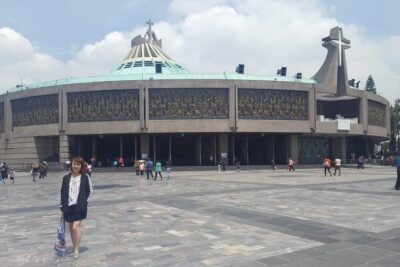
Private Tour: Teotihuacan and Guadalupe Shrine
Read our review →
Private City Tour in Frida Kahlo, Coyoacan, and Xochimilco
Read our review →
Mexico City Custom Private Tour with a Local, Highlights & Hidden Gems
Read our review →
Teotihuacan Private Tour with Expert Guide & Cultural Insights
Read our review →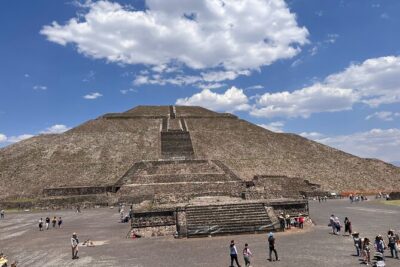
100% Private Tour in Teotihuacán Pyramids from Mexico City
Read our review →