
Reviewed · MEXICO CITY FOOD TOURS
Azcapotzalco: Mexico City’s Culinary Kaleidoscope
Azcapotzalco gives you a side of Mexico City that many visitors miss. This small-group food walk moves from cafe de olla and sweet bread to destination-quality huevos, offal tacos, handmade tortillas, old-style drinks, and a cocktail in a 110-year-old cantina. The food tells the neighborhood’s story better than any polished sightseeing route could.
I like the way the experience connects ordinary local stops with serious cooking. I also like the maximum of seven people, which keeps the walk personal and makes it easier to follow a guide such as Liz through back streets and food stalls.
The main caution is the sheer amount of food packed into one morning and afternoon. If your stomach is sensitive, eat lightly beforehand, take small bites and sips, and plan this for a day when you do not have a long dinner or important activity afterward.
Key points about the Azcapotzalco food walk
- A full food day for $140: The price covers a six-hour experience with many tastings, drinks, and an English-speaking guide.
- Breakfast comes in two rounds: Start with cafe de olla and sweet bread, then move on to huevos encamisados, enchiladas, juice, and more.
- Azcapotzalco supplies the setting: The route uses neighborhood streets, a family-run restaurant, a tortilleria, a street stand, and a historic cantina.
- The menu crosses social lines: You may eat polished egg dishes, humble offal tacos, traditional drinks, and Italian-influenced cantina food in one outing.
- Small groups matter: With no more than seven people, you get a better chance to hear the guide and keep up at each stop.
- Bring an appetite and caution: There are bathroom stops, but the amount of food can be hard on an unprepared stomach.
Why Azcapotzalco makes a strong food-tour setting
Mexico City food tours often focus on famous central districts. This one heads to Azcapotzalco, a part of the city with a strong local identity and a collage of old and new food traditions.
The meeting point is Plaza del Árbol de la Noche Triste in Popotla, where the experience begins at 10:00 a.m. The plaza provides a useful first marker for a walk built around memory, movement, and food. Along the way, you get monumental reminders of the city’s past as well as quieter corners that are easy to miss when you stay on the main sightseeing routes.
I like this approach because the neighborhood is not treated as a backdrop for a string of random snacks. Each stop connects to a part of Azcapotzalco’s character, from slaughterhouses and tortilla-making to drinks with roots reaching back to Aztec times and a cantina founded by an Italian family.
You should expect plenty of walking. One person found the amount of walking worthwhile because it opened up unfamiliar parts of Mexico City, but this is not a sit-down tasting with a few short transfers. Wear comfortable shoes and leave room in your schedule.
More food tours in Mexico City:
- Historic Center Food Tour in Mexico City
★ 5.0 · 1,263 reviews - Xochimilco Barco Fiesta Tentacion 18+ with Open Bar and Tacos
★ 5.0 · 1,209 reviews - Lucha Libre Tickets & Tacos & Beer & Mezcal – BEST NIGHT EVER!
★ 5.0 · 1,077 reviews
Cafe de olla starts the morning with local rhythm
The first food stop follows a familiar neighborhood pattern: cafe de olla with sweet bread. This is a simple opening, but it gives you a clear sense of how the day is meant to work.
Cafe de olla is spiced coffee, traditionally associated with a slow, home-style way of serving the drink. Here, it is paired with a piece of sweet bread rather than presented as a formal coffee tasting. You get a modest first bite before the heavier dishes arrive.
That pacing is useful. You are not thrown immediately into a large plate or a line of rich samples. The coffee and bread let you settle into the group, meet your guide, and begin paying attention to how food fits into daily life in the neighborhood.
The tour is offered in English, and the guide provides the explanations as you walk. Liz is one named guide associated with the experience, and her role includes both food background and local history. The strongest part of this format is the connection between what is on your plate and what you are seeing in the streets.
The second breakfast is the culinary centerpiece
After the coffee and bread, the morning gets much more serious. At a family-run restaurant tucked into the back streets, you may try huevos encamisados, enchiladas, freshly made juices, and other dishes.
This is the point where the tour shifts from casual snack walk to a substantial food experience. The restaurant is described as one of Mexico City’s best, yet the setting remains family-run and tucked away rather than designed for passing sightseeing crowds. That contrast is part of the appeal.
Huevos encamisados are the sort of dish that makes a food tour worthwhile because you may not think to order them on your own. The menu also includes enchiladas and juice, so this is not a one-bite sample. You should treat it as a real second breakfast.
I like that the route includes a place where cooking quality is taken seriously without losing its neighborhood setting. You are not only checking off famous foods. You are seeing how a local restaurant can become a destination while still operating from an unshowy street.
The drawback is clear: if you eat a full breakfast before arriving, this stop may be too much. Start the day with coffee or something small, especially since several more tastings follow.
Offal tacos connect food to Azcapotzalco’s working past
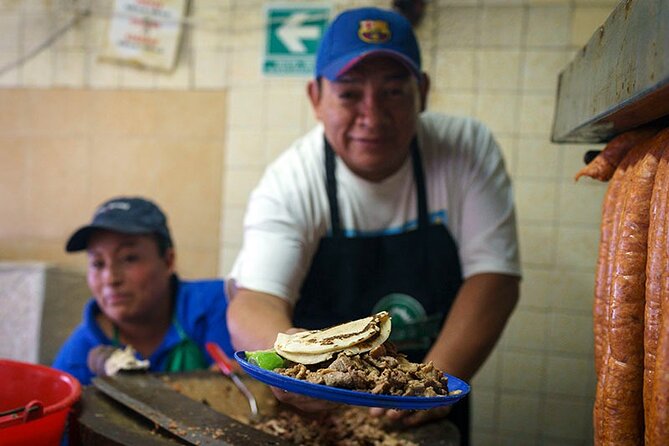
Later, the route turns to succulent offal tacos. This is the most challenging food stop for some people, but it is also one of the more revealing.
The tacos connect to slaughterhouses that were once located in the area. That context gives the dish more meaning than a generic taco tasting. You are eating something tied to the neighborhood’s former work and trade, not simply sampling a fashionable version of Mexican street food.
If you already enjoy offal, this may be one of the highlights. If you are unsure, the small-group format should make it easier to take a cautious bite rather than commit to a full serving. The experience includes many different foods, so you do not need to pretend every item is your favorite.
Food safety deserves practical attention here and throughout the day. The provider says it works with vendors that follow strict hygiene standards, but one person still became ill after the tour and remained uncomfortable for several days. You cannot predict how your body will react to a long series of unfamiliar foods, so use common sense. Take small portions when possible, sip slowly, and remember that the tour includes bathroom stops.
A completely different kind of day in Mexico City:
- Teotihuacan, Guadalupe Shrine & Tlatelolco Day Tour with Lunch
★ 5.0 · 11,603 reviews - Xochimilco, Coyoacan and Frida Kahlo with Optional Lunch
★ 4.5 · 7,320 reviews - Balloon flight + Breakfast in cave + Pyramids + Pick up CDMX.
★ 5.0 · 6,335 reviews - Teotihuacan pyramids morning or afternoon without tourist traps
★ 5.0 · 6,186 reviews
A tortilleria shows the value of the everyday
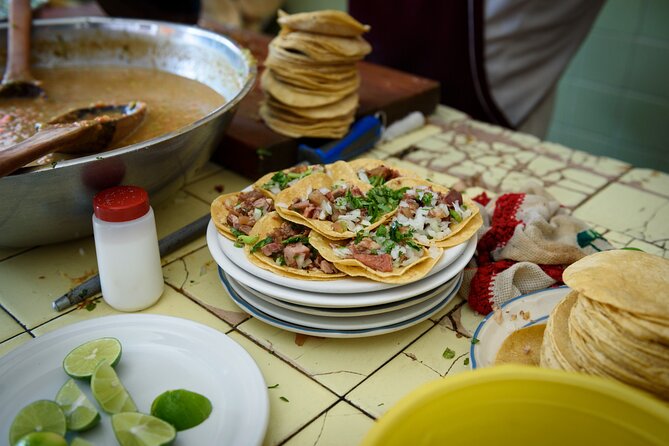
The stop at an artisanal tortilleria is easy to underestimate. Tortillas are so central to Mexican food that visitors can overlook the skill and labor behind them.
Here, the focus shifts from finished dishes to a basic ingredient made with care. An artisanal tortilleria gives you a chance to see the food system at a more immediate level, especially after eating restaurant dishes and tacos.
This kind of stop also keeps the route from becoming a parade of large meals. It gives the guide another way to explain local food traditions and shows how a staple can be treated as a craft rather than a disposable side item.
Details about the exact tasting at the tortilleria are not specified, so you should not expect a particular tortilla style or preparation beyond the visit itself. The value comes from seeing the place within the wider route and understanding how it supports the meals you have already eaten.
Aztec-era drinks add a different note
At a third-generation street stand, the tour samples drinks whose roots trace back to Aztec times. This brings a different flavor and a longer historical reach to the day.
The stand matters because it is not presented as a modern bar or a museum display. It is a family operation passed through three generations, serving drinks in a street setting. That gives you a direct link between old culinary traditions and present-day neighborhood life.
You may find this stop especially interesting if you want more than tacos and tacos with different fillings. Mexico City’s food culture includes drinks, grains, fruits, spices, and old methods of preparation, and this tasting widens the picture.
The exact drinks are not listed, so the route leaves some surprise in the glass. If you have dietary or ingredient concerns, ask your guide before drinking. You should also pace yourself, since the tour already includes coffee, juice, food, and a final cocktail.
A 110-year-old cantina closes the route
The final major stop is a cantina opened about 110 years ago by a family from Italy. This is an excellent way to finish because it shows how Mexican food traditions have absorbed outside influences without losing their own identity.
You will try the house cocktail along with small dishes that reflect classic Mexican cooking and the founders’ European roots. The meal is not described as an Italian restaurant visit. Instead, the point is the blend, a Mexican cantina shaped in part by an Italian family and carried forward for more than a century.
I like this stop because it brings the tour’s main idea into focus. Azcapotzalco is not represented by one pure food tradition. Its identity comes from layers of family cooking, street trade, older ingredients, restaurant technique, and immigrant influence.
The cocktail is another reason to think about the day’s pacing. If you do not drink alcohol, the available alternative is not stated, so ask in advance. The experience is offered in English, but specific dietary substitutions are also not provided.
What the six-hour format means for your day
The experience is listed as approximately six hours, with the detailed route divided into time around the opening meeting point, about four hours in Azcapotzalco, and a final period that brings the story together. In practical terms, plan on most of the day rather than a quick morning tasting.
That length is justified by the number of stops and the walking between them. You are not simply paying for food. You are paying for a guided route through a neighborhood, historical context, restaurant access, street food, drinks, and the work of coordinating a group across several locations.
The schedule also means you should avoid placing a major meal immediately afterward. By the end, you may have had coffee, bread, eggs, enchiladas, juice, tacos, tortillas, traditional drinks, cantina dishes, and a cocktail. The amount is generous, but it can be a drawback if you prefer small, carefully measured tastings.
The tour ends back at the meeting point. That makes planning easier because you do not need to arrange a return from a different neighborhood. The starting point is near public transportation, which helps if you are making your own way there.
Is $140 a fair price?
At $140 per person, this is not a cheap eat-and-walk outing. The right comparison is not the cost of buying one taco at a street stand. You are paying for a six-hour guided experience, a maximum group of seven, many food and drink stops, and access to a part of Mexico City that can be difficult to understand without local context.
The price makes more sense if you value range. In one day, you move from sweet bread and coffee to a family-run restaurant, offal tacos, handmade tortillas, traditional drinks, and a historic cantina. You also get explanations about the neighborhood and the food rather than having to research each stop yourself.
It may feel expensive if you mainly want a large plate of tacos or prefer to explore independently. You will also need to decide how much value you place on the guide’s storytelling. For me, the strongest case for the price is the combination of food and place. The route shows how the dishes relate to Azcapotzalco’s past and present.
The maximum of seven is important. A small group makes street stops easier and reduces the chance that explanations disappear into a crowd. It also helps if you have questions about ingredients or want to slow down at a particular stop.
Practical details before you book
The activity is offered in English and uses a mobile ticket. Confirmation normally arrives when you book, though bookings made within one day of departure are confirmed as soon as possible, subject to availability.
Most people can participate, and service animals are allowed. The experience is near public transportation, but the supplied information does not specify the exact transit route, walking distance, or accessibility of every food stop. If you need detailed mobility information, ask before booking.
The cancellation policy is straightforward: cancel at least 24 hours before the 10:00 a.m. start for a full refund. Changes or cancellations made within 24 hours are not refunded. Poor weather can also cancel the outing, in which case you are offered another date or a full refund. The same applies if the minimum number needed to operate the experience is not met.
Who should book this Azcapotzalco experience?
I would choose this tour if you want to understand Mexico City through food rather than only through major sights. It suits adventurous eaters who are open to offal, traditional drinks, family-run restaurants, and dishes that may not appear on a standard tourist menu.
It is also a good match if you enjoy walking and prefer a small group. The guide’s mix of food explanation and neighborhood history is a major part of the value, especially if you want context instead of a list of ingredients.
I would think twice if you have a sensitive stomach, dislike eating several times in one day, or want a short and predictable tasting. You can pace yourself, but the menu is broad and the schedule is long. Put this outing early enough in your trip that you have time to recover if something does not agree with you.
Should you book it?
Book this experience if the idea of eating your way through an overlooked Mexico City neighborhood sounds better than following a standard sightseeing route. The combination of huevos encamisados, offal tacos, handmade tortillas, old-style drinks, and an Italian-founded cantina gives the day real variety.
Skip it if you want a bargain meal, dislike unfamiliar ingredients, or need firm control over portions and timing. For the right eater, the $140 price buys more than food. It buys a small, guided look at how Azcapotzalco works, remembers, and eats.
FAQ
Where does the Azcapotzalco food tour begin?
It begins at Plaza del Árbol de la Noche Triste in Popotla, Mexico City.
What time does the tour start?
The tour starts at 10:00 a.m.
Where does the experience end?
The activity ends back at the meeting point.
How long does the tour last?
The experience lasts approximately six hours. The detailed schedule includes about four hours in Azcapotzalco, along with time at the opening and closing points.
What language is the tour offered in?
The tour is offered in English.
How many people can join the tour?
The maximum group size is seven people.
What food and drinks are included?
The route includes cafe de olla, sweet bread, huevos encamisados, enchiladas, freshly made juices, offal tacos, an artisanal tortilleria visit, traditional drinks with Aztec-era roots, a house cocktail, and small cantina dishes.
Is the tour suitable for most people?
Most people can participate. Service animals are allowed, and the meeting area is near public transportation.
Can I cancel for a refund?
You can receive a full refund if you cancel at least 24 hours before the start time. Cancellations or changes made within 24 hours are not refunded. If poor weather or an insufficient minimum group causes cancellation, you are offered another date or a full refund.
Just added around Mexico City
- Xochimilco’s Wild Side: Mezcal, Insects & Culture★ 4.9 · 10 reviews
- Xochimilco: Island of the Dolls Tour Games and Drinks★ 5.0 · 25 reviews
- Xochimilco Ecological Tour – Away From the Crowds (3 Hours)★ 5.0 · 15 reviews
- Xochimilco: Food and Trajinera Ride with Local Women★ 5.0 · 5 reviews
- Xochimilco + Coyoacán Combo Full-Day Tour★ 5.0 · 3 reviews
- Xochimilco floating gardens, Coyoacan and UNAM murals★ 4.0 · 6 reviews
- Val´quirico And The City of Angels Puebla From Mexico City★ 5.0 · 3 reviews
- Xochimilco: amanecer en kayak Ciudad de México★ 5.0 · 35 reviews
Mexico City Food Tours, compared.
Xochimilco Barco Fiesta Tentacion 18+ with Open Bar and Tacos
Read our review →
Lucha Libre Tickets & Tacos & Beer & Mezcal – BEST NIGHT EVER!
Read our review →
Frida Kahlo VIP [Museum Tickets Included] Bike, Markets & Churros
Read our review →
Frida Kahlo VIP [Museum Tickets Included] Walk, Markets & Churros
Read our review →
Mexico City Historical Centre Food Tour with 7 Authentic Tastings
Read our review →
Local Foodie Adventure in Mexico: +10 dishes with Sherpa Tours
Read our review →Browse the lists this tour appears in