
Reviewed · MEXICO CITY HISTORIC CENTER WALKING TOURS
Mexico City at Night Tour with Torre Latino
Mexico City reveals its layers quickly on this evening walk. In about two hours, you move from the Palace of Fine Arts to the Zócalo, Metropolitan Cathedral, Templo Mayor, and Torre Latinoamericana, with a guide explaining how Aztec, colonial, and modern Mexico City share the same streets. I like the compact route and the fact that it begins at 6 pm, a useful fit for a first evening in town.
I also like the final stop at Torre Latinoamericana, especially if you choose the option with observation-deck access. The main drawback is that this is an overview, not a deep visit inside each landmark. You see some buildings from outside, and the quality of the evening depends heavily on your guide and on finding the meeting point without confusion.
Key points to know before booking
- Seven central landmarks in two hours: The route covers Bellas Artes, Palacio Postal, the House of Tiles, the Zócalo, the cathedral, Templo Mayor, and Torre Latinoamericana.
- A strong first-night orientation: You get names, dates, and context before returning to explore places on your own.
- Torre Latino access is option-dependent: Check your selected package carefully, since the observation ticket is not included with every booking.
- Guides can make the difference: Alexa, Carlos, Bernardo, Edith, Emanuel, and Alejandro have been praised for clear explanations, humor, and friendly group leadership.
- Keep the meeting point details handy: The tour starts at Av. Hidalgo 2 at 6 pm, and past problems have involved guests and guides failing to connect.
- Expect a small-group walk: The maximum group size is 20, and comfortable walking shoes are important.
Why this evening route works so well
At $26 per person, this tour is priced as an affordable introduction to central Mexico City. You are paying mainly for the guide’s commentary and the convenience of a fixed route, not for entry into a long list of museums. That distinction matters.
If you already know the historic center and enjoy researching buildings as you go, you can cover much of this route independently. If you are arriving for the first time, the guide helps connect details that otherwise look like a collection of handsome facades and crowded plazas. The city’s past is not presented in neat sections. Aztec ruins sit beside Spanish colonial churches, while early twentieth-century architecture and a modern skyscraper fill the same short walk.
The tour lasts about two hours, with roughly ten minutes at most stops and about 20 minutes at Torre Latinoamericana. That gives you a brisk overview rather than a slow architectural study. I see this as a good use of your first evening, especially if you want a sense of direction before planning longer visits.
The walk is offered in English, and the group can include up to 20 people. One guide, Emanuel, was praised for switching comfortably between English and Spanish with a mixed group. Bernardo was also able to speak French, which helped a French-speaking couple, though you should book this as an English tour rather than count on a particular second language.
More walks through the historic centre:
- Historic Downtown Walking Tour
★ 5.0 · 1,289 reviews - Historic Center Food Tour in Mexico City
★ 5.0 · 1,263 reviews - Mexico City: Historic Downtown Walking Tour
★ 4.8 · 1,039 reviews
Starting at Bellas Artes after 6 pm
The meeting point is at Av. Hidalgo 2 in Mexico City’s historic center, near the Palace of Fine Arts. The activity begins at 6 pm, so arrive early enough to locate the guide and group. This is especially important in a busy central area where a vague landmark can make a late arrival stressful.
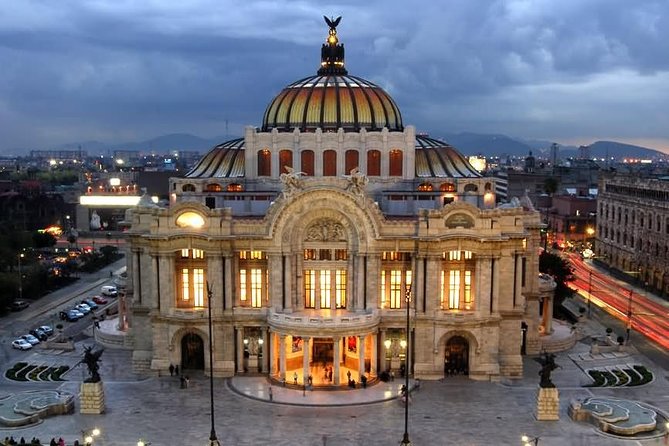
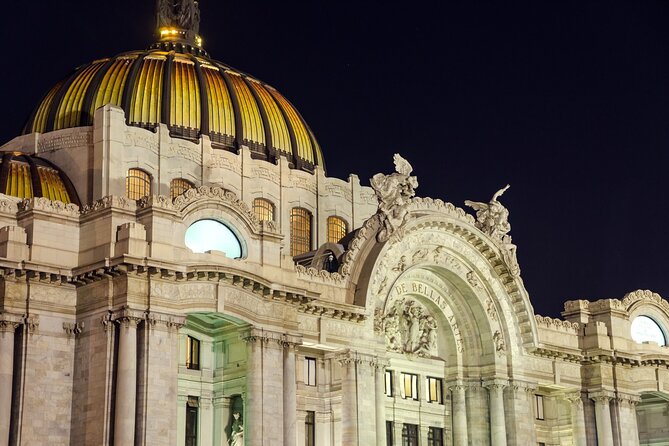
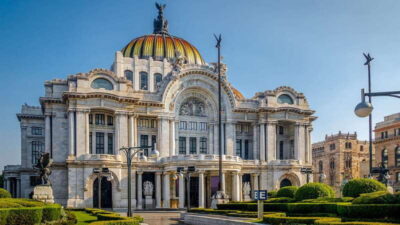
The Palacio de Bellas Artes is an excellent place to begin. It is considered Mexico City’s most important cultural venue, and its striking exterior gives the guide plenty to explain before the group sets off. The scheduled stop is about ten minutes, with admission not included.
That short pause is enough to place the building in the city’s cultural story, but not enough for an interior visit. If the murals, performances, or interior design are a major reason you came, plan a separate visit. This tour gives you orientation, not a full Bellas Artes experience.
Palacio Postal and the House of Tiles
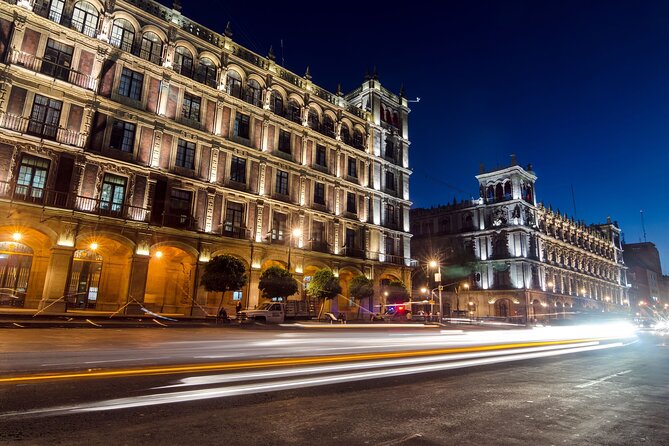
The next stop is the Palacio Postal, a grand early twentieth-century building. The tour allows about ten minutes here, and admission is free. This is one of the route’s useful contrasts: after hearing about a major cultural institution, you shift to a building associated with Mexico City’s modernizing period.
The guide’s role is important here. A facade can be admired in seconds, but its construction date and place in the city’s growth make it more meaningful. You will learn more by listening than by simply walking past.
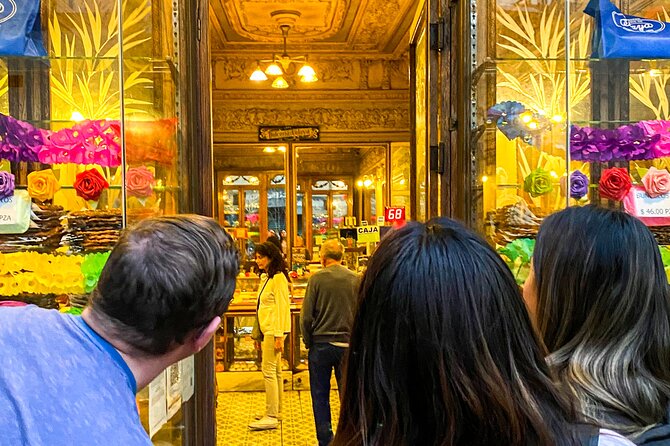
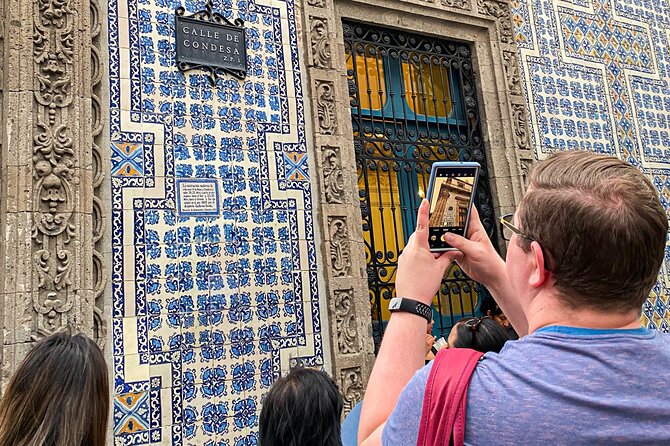
Calle Madero then brings you to the House of Tiles, or Casa de los Azulejos. Its roof of Puebla talavera tiles makes it one of the most memorable buildings along the route, and it is linked with New Spanish Baroque design. The stop lasts about ten minutes, and admission is not included.
I like this part of the walk because it shows how much Mexico City’s historic center offers at street level. You do not need a museum ticket to appreciate the facade, but the guide can point out why the building matters. If you want to inspect details carefully or take many photographs, the fixed schedule may feel quick.
The Zócalo and Metropolitan Cathedral
From Calle Madero, the route continues to the Zócalo, Mexico City’s central square. This is one of the walk’s most useful stops because the open space helps you understand the scale of the historic center. The tour allows about ten minutes, and there is no admission charge.
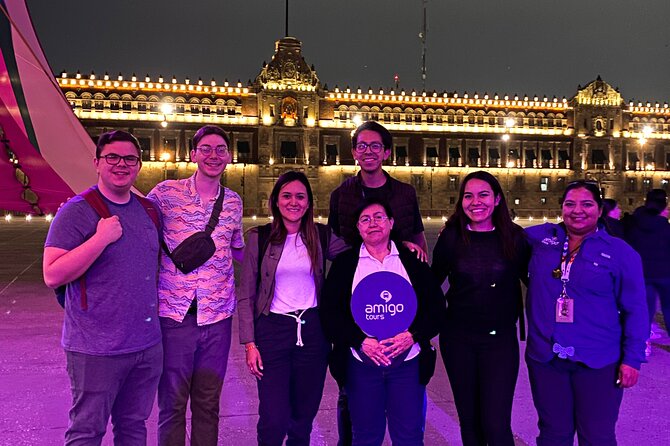
The guide explains the National Palace and the surrounding civic setting. The palace is not listed as a separate timed stop, but you see it as part of the Zócalo visit. This is a place where a guide adds real value: the square is impressive, but its significance is easier to grasp when someone explains how the city’s political and cultural life gathers around it.
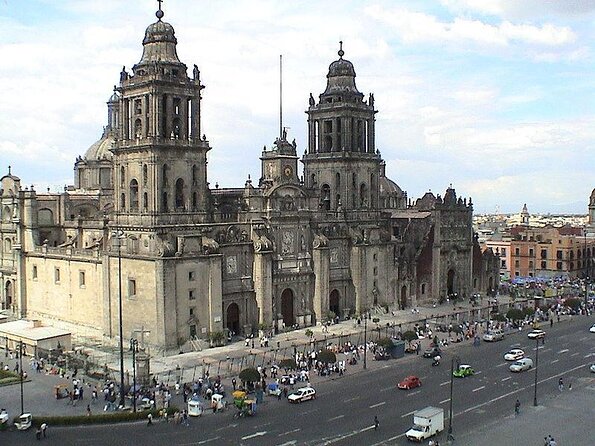
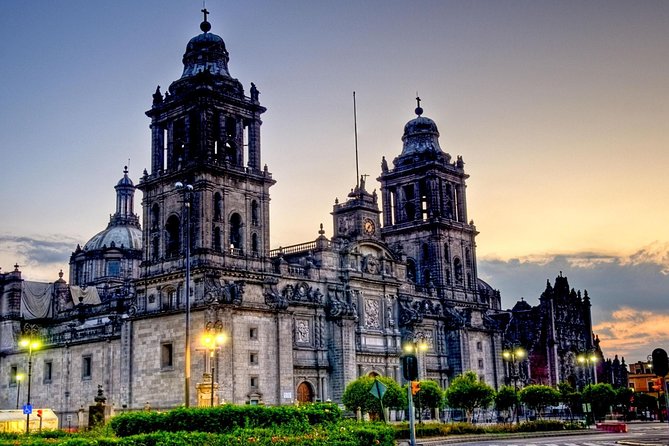
The Metropolitan Cathedral follows. It is one of the key examples of Spanish-American architecture and has been a UNESCO World Heritage Site since 1987. The tour gives you about ten minutes here, with admission not included.
That timing means you should not expect a detailed church visit. Instead, you get an exterior look and historical context. If you want to enter, pray, study the interior, or spend time with the architecture, you will need to return on your own. The benefit of seeing it during the walk is that you understand its place beside the Zócalo and the ruins of Templo Mayor.
More nights out in Mexico City:
- Mexico City: Double Decker Bus Night Tour
★ 3.8 · 373 reviews - Hop-on Hop-off or Night Tour Tourist Bus in Mexico City
★ 3.0 · 127 reviews - Night Tour of Mexico City Panoramic Ride on a Double-Decker Bus
★ 3.5 · 74 reviews - Mexico City: Guided Pub Crawl with Party Games
★ 4.8 · 42 reviews
Templo Mayor and Mexico City’s layered past
The route then reaches the Museo del Templo Mayor. The guide views the ruins from outside and explains their history. Admission is not included, and the scheduled time is about ten minutes.
This is one of the most important ideas on the tour. Mexico City is not simply a colonial city with a few older remains. The ruins point to the Aztec ceremonial center that existed before the Spanish conquest, while the cathedral and surrounding colonial buildings show what came later. The walk lets you see those layers within a short distance of one another.
Still, outside viewing has limits. You will not explore the museum galleries or archaeological areas in detail during this experience. I would treat the stop as an introduction that helps you decide if a separate Templo Mayor visit deserves space in your schedule.
The guide’s explanation matters here more than at almost any other point. Without context, archaeological remains can look fragmentary. With a good explanation, the location becomes a key to understanding why central Mexico City feels so historically dense.
Finishing at Torre Latinoamericana
The walk ends at Torre Latinoamericana, one of Mexico City’s best-known modern landmarks. The 44-floor skyscraper was inspired by New York’s Empire State Building and once held the title of Mexico City’s tallest building.
This finish gives the tour a pleasing change of scale. You begin among cultural buildings, churches, ruins, and colonial streets, then end beside a tower that represents a newer phase of the city. The guide discusses its construction and importance before the group separates.
If you select the package with viewpoint access, your Torre Latino ticket is included. You then have free time to go up independently and see Mexico City from the observation level. The view is the strongest reason to choose this option. After walking through the historic center, you can look back across the city and place the route within a much larger setting.
Check the package carefully before paying. Torre Latino access is included only if you choose the appropriate option. If you do not select it, the tour still finishes at the tower, but the observation ticket is not part of your booking.
The tower stop is listed at about 20 minutes, though the independent viewpoint visit may require you to manage your own time at the end. Food and drinks are not included, so plan a snack or meal separately.
The guide can shape the whole evening
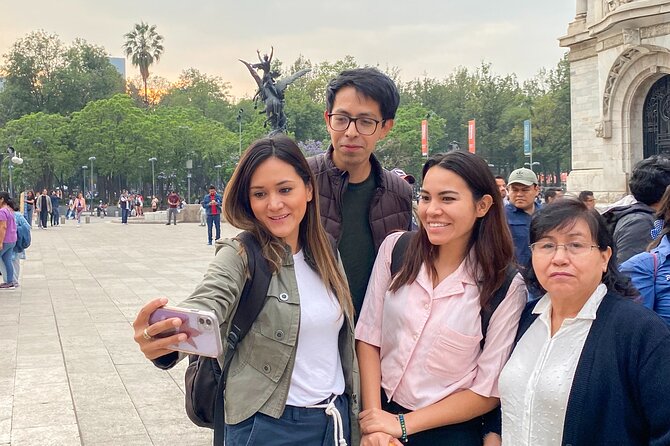
The strongest part of this experience is the human explanation. Several guides have received especially warm praise for their delivery.
Alexa has been described as a lively storyteller who uses photographs, a whiteboard, historical details, humor, and inventive explanations. That style can be especially helpful when a group includes people with different levels of background knowledge. One difficult evening included a heavy thunderstorm at the start, yet her enthusiasm helped keep the walk enjoyable.
Carlos was praised for keeping both language groups involved. Bernardo provided strong architectural and historical explanations, while Edith was friendly and informative for a solo participant. Emanuel handled a mixed English and Spanish group with ease, and Alejandro was praised both for his cultural explanations and for helping a solo visitor feel secure.
These examples also point to the tour’s main uncertainty. Guide quality can vary. One unhappy participant described guides who rushed, made distracting jokes, and did not communicate well at the end. That is not a reason to reject the route, but it is a reason to keep expectations realistic. You are booking a group service, and the personality leading your walk will matter.
Safety, pace, and practical comfort
The tour takes place in central Mexico City after dark. Solo participants have described feeling safe within the group, and the route stays in a central area with major landmarks and access to public transportation. That does not remove the need for normal city awareness, but the guided format can make a first evening feel less uncertain.
You should wear comfortable clothes and proper walking shoes. The route is not described as strenuous, but you will be on your feet for about two hours, with stops rather than long seated breaks. Rain is possible, and one group continued through a thunderstorm, so a light rain layer or compact umbrella would be sensible.
Service animals are allowed, and most people can participate. The tour is near public transportation. The group maximum is 20, which is small enough for a guide to address the group, though it is not a private walk.
The most important practical warning is the meeting point. Several poor experiences involved people waiting, failing to locate the guide, or receiving unclear directions. Use the exact address, arrive before 6 pm, and keep your booking confirmation available. Do not assume that simply waiting near a large museum or park will be enough.
Who should book this tour?
I would recommend this walk to a first-time visitor who wants a fast, guided introduction to central Mexico City. It suits solo visitors, couples, and families who would rather follow a clear route than spend their first evening studying maps. The English commentary, central location, and short duration make it easy to fit into a busy trip.
It also works well as a first-night orientation. Afterward, you can return to Bellas Artes, the cathedral, Templo Mayor, or the House of Tiles with a better sense of what you are seeing.
I would be less enthusiastic if you want long interior visits, detailed museum time, or a private guide. The tour spends about ten minutes at most stops, and several landmarks are viewed from outside. You also need to verify that your chosen package includes Torre Latino access if the viewpoint matters to you.
The $26 price is fair for a compact guided walk and potentially excellent if your guide is as engaging as Alexa, Carlos, Edith, Emanuel, Bernardo, or Alejandro. It is less compelling if you already know the historic center or are comfortable creating your own route. In that case, the main purchase is convenience and commentary.
Should you book the Mexico City at Night Tour?
Book it if you want a short, useful introduction to Mexico City’s historic center, particularly on your first evening. Choose the Torre Latino option if you want the walk to end with a panoramic view and do not want to arrange that visit separately.
Before booking, confirm the exact meeting address and arrive early. Expect an outside-focused tour, a brisk pace, and guide quality that can vary. With the right expectations, this is a good-value way to connect Bellas Artes, the Zócalo, Templo Mayor, and Mexico City’s modern skyline in one manageable evening.
FAQ
How long does the Mexico City at Night Tour last?
The tour lasts approximately two hours.
What time does the tour begin?
The tour begins at 6 pm.
Where does the tour start?
It starts at Av. Hidalgo 2 in Mexico City’s historic center, near the Palace of Fine Arts.
Where does the tour finish?
The tour finishes at Torre Latinoamericana, at Eje Central Lázaro Cárdenas 2.
Is the Torre Latinoamericana viewpoint ticket included?
It is included only if you select the option with viewpoint access. The ticket is not included with every package.
Is the tour offered in English?
Yes. The tour is offered in English. The group may include people speaking other languages, but you should book it as an English-language experience.
More evening outings in Mexico City
- Lucha Libre Tickets & Tacos & Beer & Mezcal – BEST NIGHT EVER!
★ 5.0 · 1,077 reviews - A Night of Tacos and Mezcal in Mexico City
★ 5.0 · 262 reviews - Mexico City: Night City Tour in a Double Decker Bus
★ 4.2 · 235 reviews - Narvarte At Night: Tacos, Chelas & Mezcal
★ 5.0 · 216 reviews
Just added around Mexico City
- Xochimilco’s Wild Side: Mezcal, Insects & Culture★ 4.9 · 10 reviews
- Xochimilco: Food and Trajinera Ride with Local Women★ 5.0 · 5 reviews
- Xochimilco: Island of the Dolls Tour Games and Drinks★ 5.0 · 25 reviews
- Xochimilco Ecological Tour – Away From the Crowds (3 Hours)★ 5.0 · 15 reviews
- Xochimilco + Coyoacán Combo Full-Day Tour★ 5.0 · 3 reviews
- Xochimilco floating gardens, Coyoacan and UNAM murals★ 4.0 · 6 reviews
- Xochimilco: Eco Tour With Food★ 4.8 · 7 reviews
- Val´quirico And The City of Angels Puebla From Mexico City★ 5.0 · 3 reviews
Mexico City Historic Center Walking Tours, compared.




Walking Tour – Impressive murals in Historical Center of Mexico City
Read our review →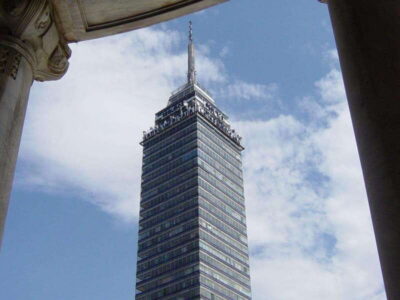
Muralist Art Semi Private Walking Tour in Mexico City Downtown
Read our review →Browse the lists this tour appears in